Dosage is one of the decisive factors that shape the character of a Champagne. In this blog article, we explore what dosage actually means, the role it plays in the production of Champagne, and how it influences flavour, balance, and style. You will learn why winemakers deliberately add different amounts of sugar after the second fermentation in the bottle, and how this decision becomes noticeable in the glass – from Brut Zero to Doux. With clear explanations, practical examples, and an eye for detail, this article helps you understand the world of Champagne even better and enjoy it more consciously. Discover how dosage is part of the great diversity of Champagne and why it is far more than just a technical term.
The dosage is the final touch on the way to the finished Champagne, applied immediately after disgorgement.
This moment inevitably calls for a balance to compensate for the unavoidable loss, however small it may be. Since early times, Champagne winemakers have used this opportunity for the final refinement of their wines by not simply replacing the loss with fermented wine, but with a more or less sweet “liqueur de dosage.”
This liquid is usually made of cane sugar dissolved in wine and is traditionally also referred to as “liqueur d’expédition,” or “shipping dosage.” The sweetness level of this liqueur varied significantly well into the 20th century, depending on the taste preferences of the respective export markets.
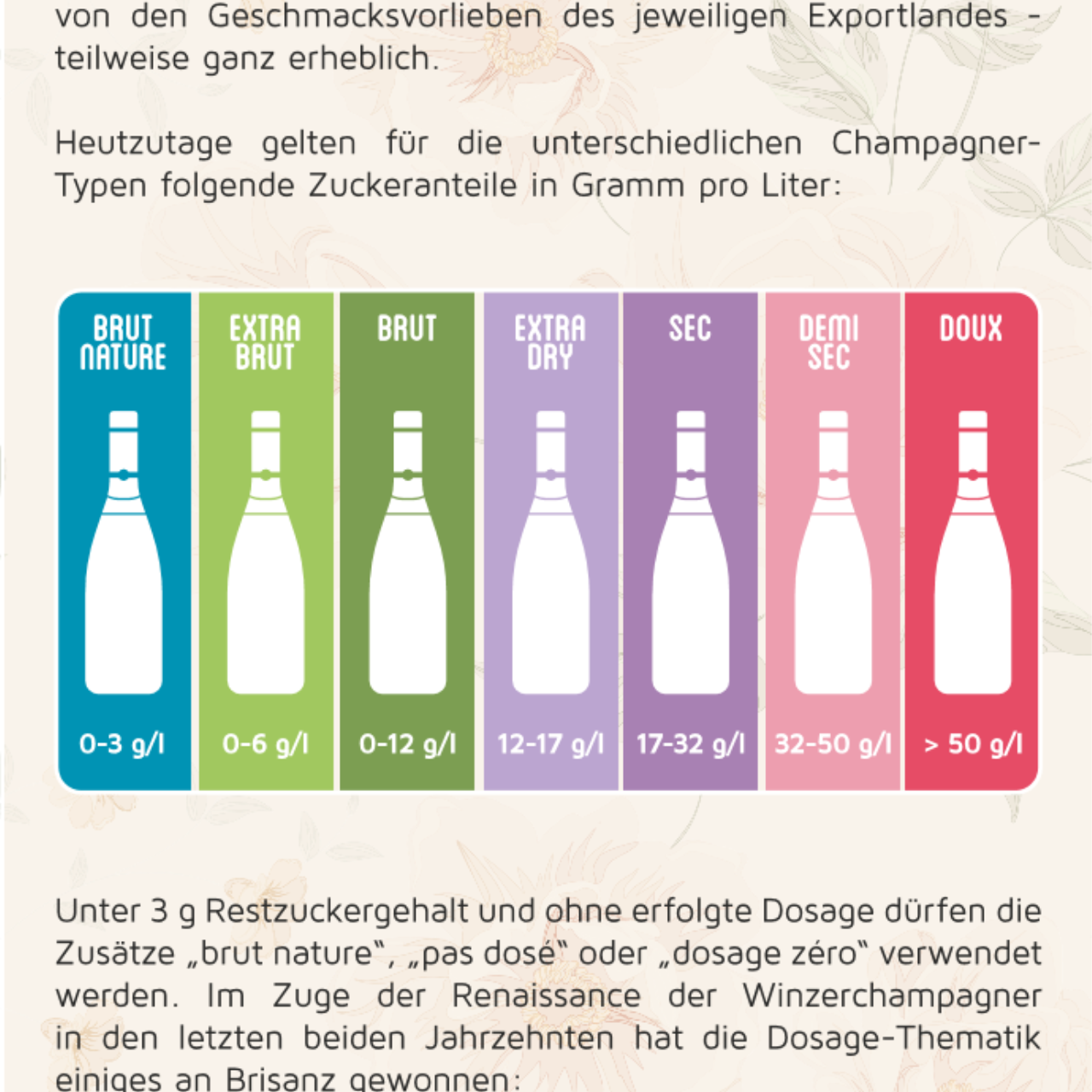
Today, the following sugar levels (in grams per litre) are defined for the different Champagne styles:
-
doux: over 50g
-
demi-sec: 32–50g
-
sec: 17–32g
-
extra dry: 12–17g
-
brut: under 12g
-
extra brut: under 6g
Below 3g residual sugar and without any added dosage, the terms “brut nature,” “pas dosé,” or “dosage zéro” may be used.
In the course of the revival of grower Champagne over the past two decades, the topic of dosage has become increasingly controversial. Whether a Champagne receives a few grams more or less residual sugar is, for many contemporary Champagne lovers, no longer purely a matter of personal taste.
At times, it almost appears to be an ideologically charged debate, with two opposing camps facing each other quite uncompromisingly. One side argues—rightly, in their view—that perfectly ripe grapes from well-tended vineyards produce wines harmonious enough to do without added sugar. For them, dosed Champagnes are “made up,” with sugar merely masking insufficient ripeness caused by poor vineyard work. The trend towards low- or zero-dosage Champagnes observed in recent years in fine dining and wine criticism seems to support their position.
However, caution is needed: still today, handcrafted grower Champagnes with very low or zero dosage represent only a very small share of total production in the region. What appeals to so-called experts does not necessarily reflect the realities of the market.
On the other side of the debate, dosage advocates also present valid stylistic arguments. In their view, a carefully considered dosage not only brings greater harmony and consistency across vintages, but can also enhance complexity—especially when the sugar is dissolved in reserve wines, contributing far more than just sweetness to the final composition.
At Champagne Characters, we maintain our usual relaxed enjoyment-driven perspective and continue to seek out the best of both worlds for our customers.