


Côte des Bar
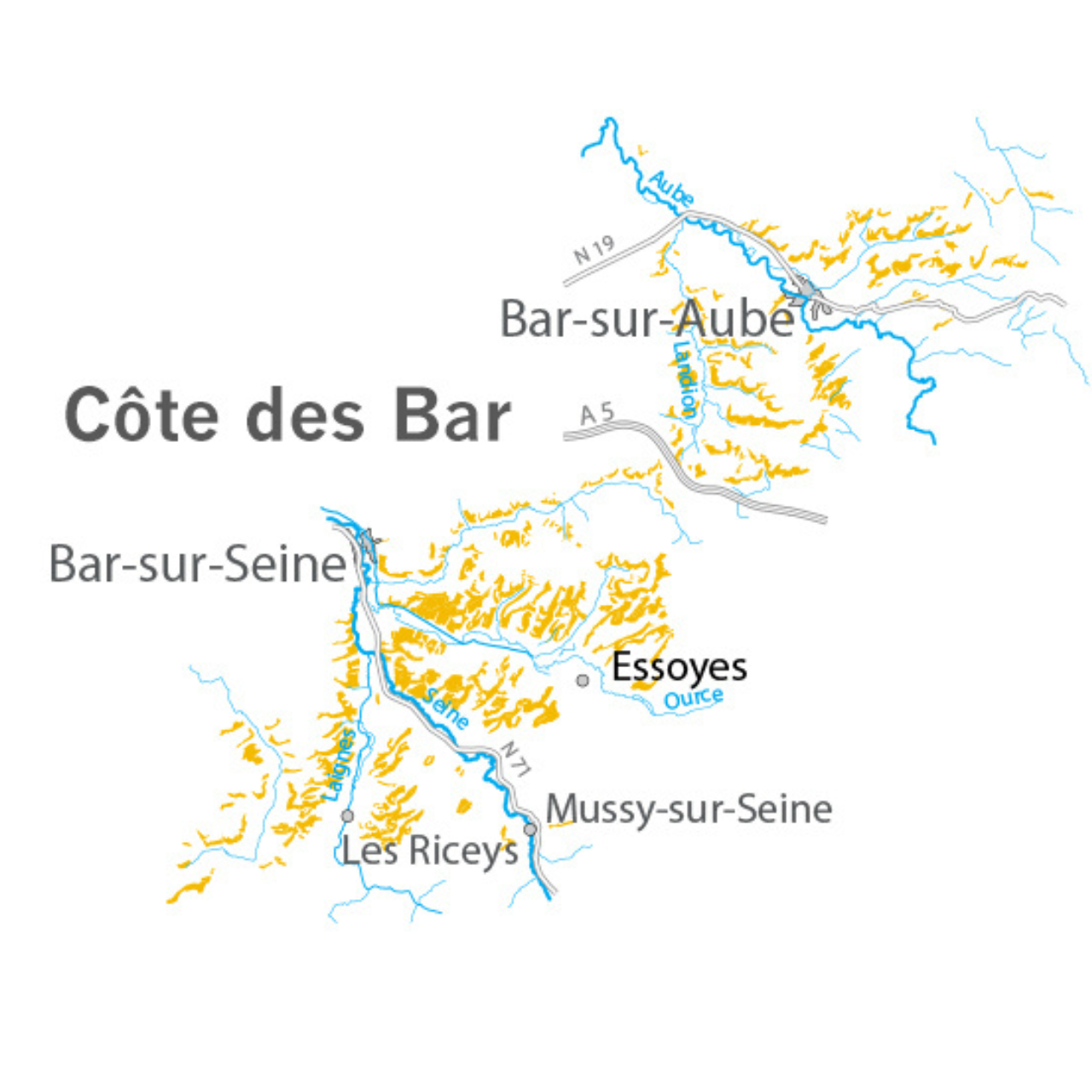
The Champagne region is an exceptionally vast wine-growing area with parts that differ significantly in terms of climate and soil composition. This becomes particularly evident when examining viticulture in the Aube department, located in the far south of the region. The largest vineyards—covering more than 7,000 hectares—are spread across the renowned Côte des Bar, whose picturesque capital is Troyes. Situated along the banks of the Seine and Aube rivers, this area is geographically closer to Burgundy than to the heartland of Champagne. While Épernay lies approximately 100 kilometers away, Chablis seems just around the corner. This location naturally has a significant impact on the local microclimate, which is more continental in character, featuring colder winters and warmer summers.
The terroir of the Aube department is also remarkably similar to that of Burgundy. Unlike areas such as the Côte des Blancs, the underlying limestone soils are not exposed at the surface but are covered by varying depths of clay. All of these factors directly influence the character of the region’s wines. Pinot Noir dominates the vineyard landscape and produces particularly powerful, fruit-driven, and well-structured wines with a tendency toward high ripeness. These wines often remind experienced tasters of fine Burgundy wines. Only in the small enclave of Montgueux, near Troyes, does Chardonnay dominate. Even here, the wines are widely regarded as some of the most “Burgundian” in all of Champagne.
Historically, the Aube is an ancient wine-producing region, with the earliest traces of viticulture dating back to Gallo-Roman times. During the Middle Ages, Troyes served as the seat of the Counts of Champagne, and from the 12th century onward, the monks of Clairvaux, near Urville, one of today’s key centers of wine production, cultivated vineyards on a significant scale. For many centuries, however, Gamay was the dominant grape variety, primarily used to produce simple still wines for local consumption. A surviving legacy of this tradition is the famous and highly sought-after Rosé des Riceys, which is now typically made from Pinot Noir.
In 1908, winegrowers from the central Champagne region successfully obtained a decree in Paris stating that sparkling wines produced in the Aube could not be labeled as Champagne. When this ruling became law in 1911, it sparked the Champagne Winegrowers’ Revolt in the Aube, resulting in violent clashes, several deaths, and intervention by the French army. On June 7, 1911, the government finally relented and amended the law. The Aube was granted the status of a “deuxième zone,” meaning its producers could market their wines only as a form of second-tier Champagne.
Following this turning point, the region embraced quality grape varieties and focused increasingly on producing Champagne sparkling wines under the official Champagne appellation. To this day, no formal vineyard classification system exists in the area. Nevertheless, the Aube, and particularly the Côte des Bar along with exceptional terroirs such as Montgueux, has developed into an integral part of the modern Champagne industry. The major Champagne houses value the region’s rich and structured Pinot Noir wines as the backbone of many of their finest Champagne cuvées. Furthermore, the Aube has emerged as a creative hub of the growing grower Champagne movement, boasting an exceptionally high concentration of quality-focused, independent winemakers.